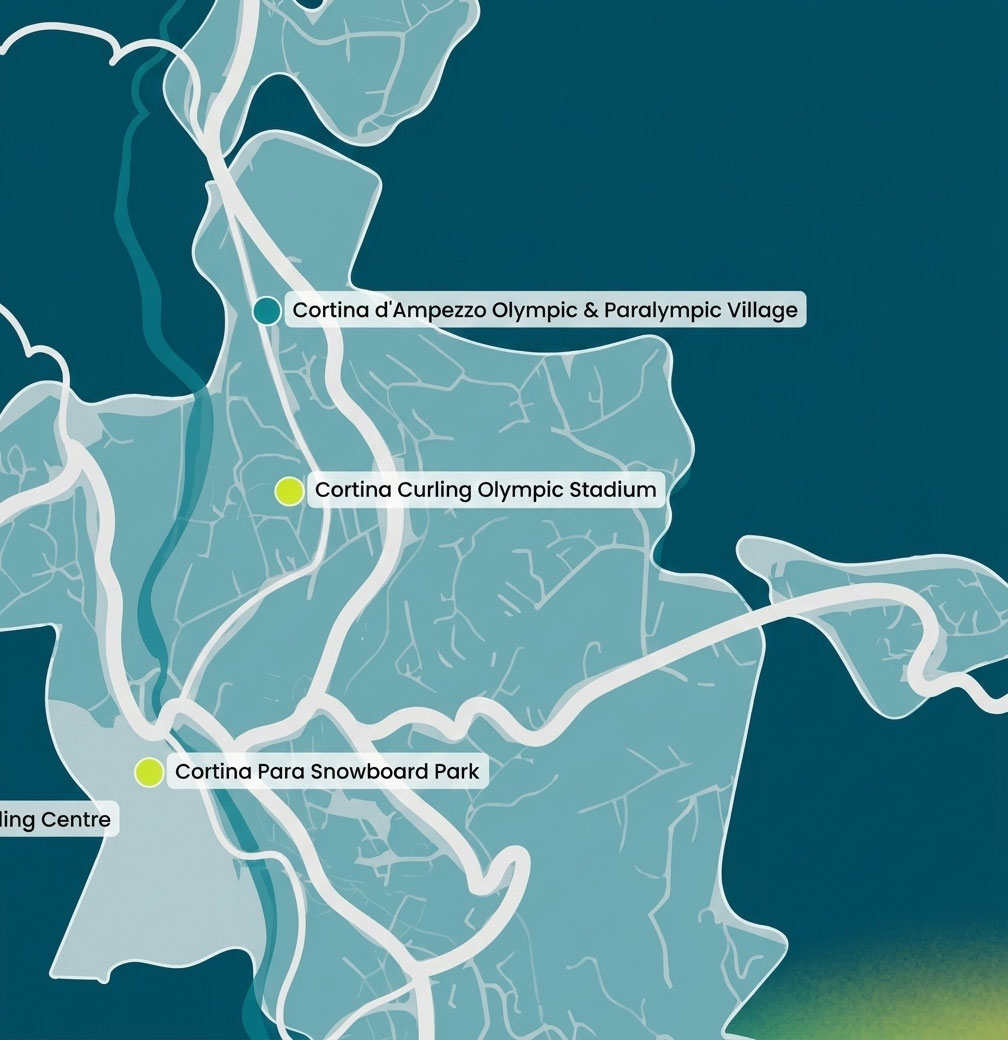
Cortina Curling Olympic Stadium
In the heart of the Dolomites, surrounded by the peaks that have long defined the identity of Cortina d’Ampezzo, the Cortina Curling Olympic Stadium is one of the symbolic venues of Milano Cortina 2026. Here, where history and future meet, curling fully expresses precision, strategy and respect—core values of the Olympic and Paralympic spirit.
Built in 1955 for the first Winter Olympic Games ever hosted by Italy, the stadium is an integral part of Cortina’s Olympic memory. In 1956, it hosted the Opening Ceremony and figure skating competitions; in 2026, on the same site, the circle will be symbolically closed. . The world’s best male and female curling athletes will compete for Olympic and Paralympic medals, delivering a spectacle of the highest technical and emotional level.
Key Features
The Cortina Curling Olympic Stadium has undergone a major renovation, with a strong focus on innovation and accessibility. The spaces have been redesigned to ensure maximum comfort for athletes, staff, media, and spectators, in full compliance with the international standards required for an Olympic event and with a clear commitment to a long-term legacy for the territory.
With a seating capacity of 3,500 during competitions and up to 3,700 for the Paralympic Closing Ceremony, the stadium becomes a place where memories of past achievements intertwine with the promise of new challenges. It stands confirmed as a renewed icon, ready to tell – once again – Cortina’s Olympic story to the world.
Cortina Snowboard Park
In the heart of the Tofane mountains, in Socrepes, the historic San Zan slope is preparing to become one of the most exciting venues of the Milan Cortina 2026 Paralympic Games. This is where the Para Snowboard competitions will take place, in a spectacular setting where technique and courage make all the difference. Athletes and athletes from every part of the a7> world will compete on a technical and fast track, ready to write new pages of sport. A unique opportunity to experience the energy of the Games up close and be amazed by the determination and talent of the athletes. The Cortina Para Snowboard Park will be able to accommodate up to 1,500 spectators, offering an engaging and intimate atmosphere. In programma otto eventi da medaglia — sei maschili e due femminili, partendo dalle specialità del banked slalom e dello snowboard cross.
Tofane Alpine Skiing Center
The Olympic women’s alpine skiing competitions, along with the women’s and men’s Paralympic alpine skiing events, will take place in the area of the Tofane Alpine Skiing Center, one of the symbolic locations of Cortina d’Ampezzo. The sports center takes its name from the Tofane range – among the most majestic mountain groups in the Dolomites – and for decades has represented an absolute benchmark and one of the most iconic stages in world alpine skiing.
During Milano Cortina 2026, the Tofane Alpine Skiing Center will host some of the most spectacular events of the Games, offering athletes an unparalleled natural, technical, and emotional setting. It is a place where tradition, landscape, and sporting performance merge into a unique experience. At the heart of the venue lies the Olympia delle Tofane, a legendary slope internationally renowned for its difficulty, beauty, and deep connection to Olympic history. A protagonist of the 1956 Winter Olympic Games, it has been a regular stop on the Women’s Alpine Skiing World Cup circuit since 1993 in the downhill and super-G disciplines. In 2021, it also hosted the Alpine Skiing World Championships, further confirming its central role on the international stage.
Key Features
With a length of 2,560 meters and a vertical drop of 750 meters, the Olympia delle Tofane slope is a concentration of power, technique, and precision. The track opens with the famous Schuss, an initial wall with a gradient reaching 64%, where extremely high speeds are achieved within the very first seconds of the race. From there, the course continues through highly technical sections that challenge balance and body control, including the Duca d’Aosta jump and the Gran Curvone – one of the most spectacular and demanding passages – followed by the Scarpadon, where physical endurance and the ability to read the terrain become decisive all the way to the finish line.
Every segment of the Olympia slope is designed to enhance athletic performance and demands courage, absolute precision, and complete mastery of speed.
The Tofane Alpine Skiing Center is not only a competition venue, but a true symbol of Cortina and of the entire world of alpine skiing. A place where the best athletes have challenged themselves for generations, leaving an indelible mark on the history of the sport.
Cortina Olympic and Paralympic Village
The Cortina Olympic and Paralympic Village is located in the Fiames area, set within one of the most scenic landscapes of the Dolomites. It is a fully temporary village, designed to accommodate athletes in a functional, accessible environment that is fully integrated into the surrounding territory.
The village consists of single-storey prefabricated residential modules, connected by accessible pathways and designed to ensure comfort, safety, and ease of movement. The main shared services are housed in larger temporary structures, centrally located near the main entrance, along a dedicated area extending for approximately one kilometer.
Across the Strada Statale 51 di Alemagna, at the Cortina Fiames Center (CFC), parking areas and ski waxing cabins are located, supporting team operational activities.
Each housing unit is a studio-type accommodation with a dedicated bathroom. The residential units comprise two rooms, one of which is accessible, for a total of 334 double rooms and 40 single rooms reserved for specific profiles, such as Heads of Delegation. The size of each unit is approximately 12 m², excluding bathroom facilities.
The Cortina Olympic and Paralympic Village has been designed with a strong focus on functionality and universal accessibility, in line with Olympic and Paralympic values.